Disclaimer: I am not a serious student of sociology, although I have had a spiffy liberal arts education. Moving along...
A post about mockery and now this. When I started this blog, I assumed it would mostly revolve around my chosen specialty/vocation. What can I say? I haven't had much to write about lately, tech-wise. I do have the following tidbit of commentary. The agreement between Microsoft and Novel about SUSE has inspired me to rewrite the well-known Gandhi quote "First they ignore you, then they laugh at you, then they fight you, then you win" to "First Microsoft ignores you, then Microsoft spreads FUD about you, then Microsoft pretends to peacefully coexist with you, then Microsoft or you crushes the other". Not as poetic, but accurate.
Enough preamble ramble. My experiences in society have reminded me of the HitchHiker's series once more. This time, it's the Somebody Else's Problem field. The SEP field is a field that accomplishes the same effect as a typical invisibility field, but by masking everything in the field as "somebody else's problem". It exploits the natural human (and all aliens?) impulse to not take responsibility for something unless necessary.
An SEP field-like effect can occur in social interactions, too. An SEP field social interaction consists of someone not acknowledging his counterpart's very existence. As I once heard someone joke, "His existence is not pertinent to my reality". The SEP field effect is not the same as ignoring someone else, because that would imply that the other person was noticed and then disregarded. It is also not the same as indifference, because that also implies an uncaring awareness of the other person. Within the SEP field, people may as well not exist at all, because in either case the impact is precisely null. In fact, this could be a useful detection method for social SEP fields. If someone's absence is not noted in any way, then clearly an SEP field may be masking that individual when he/she is present.
I should further note that the SEP field of social interaction is not a reliable indicator of cruelty or inhumanity. Simply put, someone would have to acknowledge someone else exists in order for an act of cruelty or inhumanity to occur. Those within the SEP field are not necessarily hated, ignored, low-class, etc. They're just nonexistent to others. I don't know if the SEP field has been explored in sociology, but I'm reminded of the categories of Gemeinschaft and Gesellschaft, where I think of Gemeinschaft as "society in which people interact based on relationships" and Gesellschaft as "society in which people interact based on purpose". I'm more inclined to put the SEP field of social interaction in Gesellschaft, though I suppose it really fits in neither, given that SEP fields negate normal society.
How can one defeat an SEP field? Hell if I know. Oh, wait: Hell is other people. Aw, now I'm just confused.
Saturday, November 11, 2006

Monday, November 06, 2006
how I met your Whedon
So, I've been hooked on "How I Met Your Mother" since the first episode. It's just a good show. And it happens to star Alyson Hannigan, who played Willow from Buffy. Then Alexis Denisof, who played Wesley on Buffy and then on Angel, guest-starred in a few episodes. Fun times, but relatively unsurprising considering Alyson and Alexis are married.
The trend continued when Amy Acker, who played "Fred" on Angel, managed to slip into the very last episode of season one. That makes three alumni from Whedon shows. Until tonight, when Morena Baccarin, who played Inara on Firefly, was on as, go figure, a gorgeous rival to Alyson's character. Even the most skeptical viewers would have to admit that these casting choices have gone beyond coincidental. The ultimate topper is that a miniscule role in tonight's episode, an unnamed "Guy", was played by none other than Tom Lenk, who played Andrew on Buffy! It's a conspiracy, I tell you, a conspiracy! Is anyone else seeing this? I feel like I'm taking crazy pills!
On Wednesday Nathan Fillion, who played some sort of superdemon thing on Buffy and then as Capt. Mal in Firefly, will be on Lost this week. It will also be the last episode before Lost breaks for a while so its production schedule can get caught up again. I'm thinking it will be a good one. I resisted the urge to comment on the last episode. I read online that what transpired was planned from the start, I've learned to trust the writers, and I appreciated the grand significance of it all.
For those who are keeping track, Neil Patrick Harris is gay. Not that there's--oh, I can't finish the line, it's so old and moldy.
The trend continued when Amy Acker, who played "Fred" on Angel, managed to slip into the very last episode of season one. That makes three alumni from Whedon shows. Until tonight, when Morena Baccarin, who played Inara on Firefly, was on as, go figure, a gorgeous rival to Alyson's character. Even the most skeptical viewers would have to admit that these casting choices have gone beyond coincidental. The ultimate topper is that a miniscule role in tonight's episode, an unnamed "Guy", was played by none other than Tom Lenk, who played Andrew on Buffy! It's a conspiracy, I tell you, a conspiracy! Is anyone else seeing this? I feel like I'm taking crazy pills!
On Wednesday Nathan Fillion, who played some sort of superdemon thing on Buffy and then as Capt. Mal in Firefly, will be on Lost this week. It will also be the last episode before Lost breaks for a while so its production schedule can get caught up again. I'm thinking it will be a good one. I resisted the urge to comment on the last episode. I read online that what transpired was planned from the start, I've learned to trust the writers, and I appreciated the grand significance of it all.
For those who are keeping track, Neil Patrick Harris is gay. Not that there's--oh, I can't finish the line, it's so old and moldy.
Sunday, November 05, 2006
you are who you mock
Disclaimer: I am not a serious student of pop culture studies, media or film studies, sociology, anthropology, etc., etc. Moving along...
Recently I've been paying special attention to mockery in media. Anyone with a passing acquaintance with human nature would guess correctly that the trigger was when I experienced one of the groups or subcultures I identify with being mocked. (The applicable truism is that people find it hard to even care about something unless it affects them personally).
It was on a TV show some weeks ago. I won't delve into that with any greater detail, since this is one of those cases in which specific examples might distract from considering mockery as a general concept. I will add that the remark was well-aimed and well-executed, and clearly hilarious to anyone not taking it seriously. I'm not considering here whether mockery is ethical, justifiable, effective, enjoyable, or necessary (IMNSHO: the context and degree and intention are all pivotal factors). I'm also not considering self-mockery or lighthearted mockery between friends.
For me, the interesting insight I've reached after observing the mockery of one group by another is how it defines the group doing the mocking. Even casual or off-the-cuff mockery broadcasts a group's values, mores, and norms on a huge megaphone, in fact, and in more than one sense. First, a sincere mocking reinforces the identity of the group by indicating who the group is not. We are not Them. There is no intersection between our groups, because if that were true then we would be talking trash about ourselves! Second, mockery can indicate what the mocking group fears, hates, or doesn't understand. One of the primary uses for humor is coping. Before mocking another group, I may know full well that they are not all idiots or degenerates; I may possibly be on good terms with someone in that group. But if something about that group disturbs me, I can defang it by laughing at it as if it were a characteristic of an idiot or degenerate. I simply declare it unworthy of uncomfortable consideration. Third, mockery may illustrate how a group measures the status of its members, because mockery consists of bestowing an uncomplimentary status on another group. If my group equates status with intelligence, then you could reasonably expect me to mock the intelligence of other groups. A group that values fashion may mock the clothing of others. And so on and so forth. You don't mock what you don't measure, because the funny part is how low he/she/they measure up. Fourth, the method and manner of mockery can betray a group's concepts of humor or disgust. If a group mocks another group by calling them a bunch of grues, then clearly the group believes that grues are either funny or distasteful. If I mock you by calling you a jackass or an even more colorful metaphor, then I must not think much of jackasses.
You are who you mock. More practically, even mockery can be a possible vector of understanding between groups.
Recently I've been paying special attention to mockery in media. Anyone with a passing acquaintance with human nature would guess correctly that the trigger was when I experienced one of the groups or subcultures I identify with being mocked. (The applicable truism is that people find it hard to even care about something unless it affects them personally).
It was on a TV show some weeks ago. I won't delve into that with any greater detail, since this is one of those cases in which specific examples might distract from considering mockery as a general concept. I will add that the remark was well-aimed and well-executed, and clearly hilarious to anyone not taking it seriously. I'm not considering here whether mockery is ethical, justifiable, effective, enjoyable, or necessary (IMNSHO: the context and degree and intention are all pivotal factors). I'm also not considering self-mockery or lighthearted mockery between friends.
For me, the interesting insight I've reached after observing the mockery of one group by another is how it defines the group doing the mocking. Even casual or off-the-cuff mockery broadcasts a group's values, mores, and norms on a huge megaphone, in fact, and in more than one sense. First, a sincere mocking reinforces the identity of the group by indicating who the group is not. We are not Them. There is no intersection between our groups, because if that were true then we would be talking trash about ourselves! Second, mockery can indicate what the mocking group fears, hates, or doesn't understand. One of the primary uses for humor is coping. Before mocking another group, I may know full well that they are not all idiots or degenerates; I may possibly be on good terms with someone in that group. But if something about that group disturbs me, I can defang it by laughing at it as if it were a characteristic of an idiot or degenerate. I simply declare it unworthy of uncomfortable consideration. Third, mockery may illustrate how a group measures the status of its members, because mockery consists of bestowing an uncomplimentary status on another group. If my group equates status with intelligence, then you could reasonably expect me to mock the intelligence of other groups. A group that values fashion may mock the clothing of others. And so on and so forth. You don't mock what you don't measure, because the funny part is how low he/she/they measure up. Fourth, the method and manner of mockery can betray a group's concepts of humor or disgust. If a group mocks another group by calling them a bunch of grues, then clearly the group believes that grues are either funny or distasteful. If I mock you by calling you a jackass or an even more colorful metaphor, then I must not think much of jackasses.
You are who you mock. More practically, even mockery can be a possible vector of understanding between groups.
Sunday, October 29, 2006
the Prestige
I saw The Prestige a few days ago, which itself is a somewhat momentous event because I seldom see movies in the theater unless: 1) I honestly can't stand to wait to see it, and/or 2) the movie obviously benefits from huge screen and sound. The Prestige falls in category 1, although it has a handful of impressive scenes that fit 2. The three Lord of the Rings movies, in contrast, were off the scale in both categories--just had to see those in theaters. In the case of the Prestige, the combination of a reunion between some of the people behind Batman Begins, a string of intriguing previews/ads explaining the movie concept, and a set of other people who are fun to watch on screen, Hugh Jackman and Scarlett Johansen and David Bowie and Andy Serkis, proved too irrestible.
All things considered, the Prestige is the most subdued movie I've seen in a while, if you don't count Proof, which was a DVD rental for me. This movie has deaths and injuries, but each one is staggered throughout the movie, so the usual desensitization doesn't occur. These dueling magicians don't have it out in some dark alley, at least not for a long time; they're after public embarrasment, complete career ruination, and eye-for-eye retribution. Although the two share a passion for glory and fame, they have different ways of pursuing it. Minor characters get dragged into the story as pawns, including an astoundingly eccentric Tesla, but thankfully the minors also have their own independent agendas. Michael Caine's character tries to lend some levelheadedness to those around him, but his effort is squandered. Everyone schemes and deceives so much that, fittingly enough for a movie about magicians, it's hard to tell when anyone is telling the truth.
They do tell skilled half-truths. The movie's surprises, praised and denounced by critics, don't happen like deus ex machina, but come after oft-repeated clues. The clues are important, because otherwise the solutions at the end would seem like cheats. I mostly figured out what was happening before the big reveals, but not everything. And the parts I didn't think of were related to clues that had made me think "Something must be significant about X, but what?" The end satisfied me.
Apart from the interpersonal struggles and plot machinations, the magic tricks in the movie are fun to watch, either from the perspective of the unwitting audience or the (dis)ingenious magician. Of course, at a time when movie technology has advanced to the point that animals routinely morph into people on screen, audiences are more jaded about what they see. In any recent all-talents-accepted competitions, the magicians are usually the first to go. We're accustomed to seeing fake realities on our screens, and aren't impressed. It's nice to have a movie to celebrate a simpler time when magic wasn't taken for granted.
All things considered, the Prestige is the most subdued movie I've seen in a while, if you don't count Proof, which was a DVD rental for me. This movie has deaths and injuries, but each one is staggered throughout the movie, so the usual desensitization doesn't occur. These dueling magicians don't have it out in some dark alley, at least not for a long time; they're after public embarrasment, complete career ruination, and eye-for-eye retribution. Although the two share a passion for glory and fame, they have different ways of pursuing it. Minor characters get dragged into the story as pawns, including an astoundingly eccentric Tesla, but thankfully the minors also have their own independent agendas. Michael Caine's character tries to lend some levelheadedness to those around him, but his effort is squandered. Everyone schemes and deceives so much that, fittingly enough for a movie about magicians, it's hard to tell when anyone is telling the truth.
They do tell skilled half-truths. The movie's surprises, praised and denounced by critics, don't happen like deus ex machina, but come after oft-repeated clues. The clues are important, because otherwise the solutions at the end would seem like cheats. I mostly figured out what was happening before the big reveals, but not everything. And the parts I didn't think of were related to clues that had made me think "Something must be significant about X, but what?" The end satisfied me.
Apart from the interpersonal struggles and plot machinations, the magic tricks in the movie are fun to watch, either from the perspective of the unwitting audience or the (dis)ingenious magician. Of course, at a time when movie technology has advanced to the point that animals routinely morph into people on screen, audiences are more jaded about what they see. In any recent all-talents-accepted competitions, the magicians are usually the first to go. We're accustomed to seeing fake realities on our screens, and aren't impressed. It's nice to have a movie to celebrate a simpler time when magic wasn't taken for granted.
Saturday, October 28, 2006
timelessness of humor in "Great Pumpkin"
I was flipping through the channels, saw "It's the Great Pumpkin, Charlie Brown", and to my surprise, watched almost the entire thing. Apparently, the annual showing of this special is not a fluke. It's good.
You may be thinking, "No, ArtVandalay, you're just easily amused by animation". And, well...I guess my three volumes of Looney Tunes Golden Collection DVDs would agree. Still, I don't watch cheap, crappy animation, unless it has excellent writing. C'mon, you can't sit there and say that having a cartoon character remark "Pronoun trouble" and having it make sense is only intended for kids.
Back to my main point. The only way a special that originally aired in 1966 could keep my attention would be if the humor is timeless. I'll expound on this if I can just switch into Hyper-Analytic mode...(grinding gears) (clunk). There. Here is how the humor is timeless, aside from the mere fact that it's Peanuts:
You may be thinking, "No, ArtVandalay, you're just easily amused by animation". And, well...I guess my three volumes of Looney Tunes Golden Collection DVDs would agree. Still, I don't watch cheap, crappy animation, unless it has excellent writing. C'mon, you can't sit there and say that having a cartoon character remark "Pronoun trouble" and having it make sense is only intended for kids.
Back to my main point. The only way a special that originally aired in 1966 could keep my attention would be if the humor is timeless. I'll expound on this if I can just switch into Hyper-Analytic mode...(grinding gears) (clunk). There. Here is how the humor is timeless, aside from the mere fact that it's Peanuts:
- Humor of repetition. One of the rules of comedy is that if you can find something that makes people laugh, you may as well try repeating it. Don't repeat jokes that primarily rely on surprise; it won't work, and you'll appear to be trying too hard. Most people have a finite tolerance for nonlinear humor. For instance, Aqua Teen Hunger Force cartoons start to annoy me after a couple of minutes. Charlie Brown getting a rock at each house, on the other hand, works so well that the four words "I got a rock" are now funny even out of context. Breaking up the repetitions with other kids exclaiming what they got (not rocks) effectively makes Charlie Brown's repetition stand out more.
- Visual humor. It pretty much goes without saying that references to current events can be mined for funny lines or even skits. Just as obviously, such references aren't funny out of context. Jokes about current events become jokes about historical events in an alarmingly short time. Actually, any jokes that rely on a shared cultural context don't even make sense in other cultures in the same time period. However, humor based on what the audience is seeing seems to be more universal. Dancing Snoopy, other children using Charlie Brown's head as a pumpkin model, or Charlie Brown having trouble with the scissors doesn't require anything from the audience except the capability to react to sounds and sights. This also means that visual humor can amuse people of any intelligence level.
- Tragic humor. Anyone with a shred of empathy probably feels some guilt about enjoying someone else's misfortune. If you want a fun word for this, you can refer to it as "schadenfreude", although "ferklempt" remains my personal favorite word borrowing from another language. The pettiness inside every person snickers whenever someone else endures tragedy. I think there's also some of this humor in "I got a rock". Charlie Brown is overjoyed after receiving a party invitation. Lucy explains that his name must have been on the wrong list. Linus persists in his rather self-destructive belief in the Great Pumpkin, so everyone else can make jokes at his expense. On a lighter note, Charlie Brown's recurring attempt to kick the football always seems to result in him falling on his back. Seeing people punished for false hope somehow just never gets old--ha ha, what a fool! Peanuts has to be the most depressing comic strip to ever hit the big time. Those who say that real kids aren't that cruel haven't seen enough groups of kids.
- Humor about childhood. Kids don't think things through logically, and therefore stumble naturally into comical situations. Even better, they think they know more than they do. Having Linus say "I didn't know you were going to kill it!" when Lucy slices into their pumpkin is a childish thing to say (given how deeply Linus thinks on other occasions, I think there's some inconsistency here). Not necessarily because the pumpkin wasn't a living thing (it was), but because once the pumpkin is out of the patch, it's already dead, and in any case it doesn't experience pain. Jumping into a pile of leaves while eating sticky candy falls in the same category. Lucy's overreaction to accidentally kissing Snoopy also is a case of unwarranted childhood zeal. Snoopy's vivid journey into his own imagination is another childhood trait. This humor doesn't appeal to me as much as it might to others, seeing as how I didn't relate to kids even when I technically was one, but it's certainly timeless, at least in parts of the world where a peaceful childhood is still possible and until the damn dirty apes take over.
- Reapplying old sayings. This kind of humor seems to be one of the identifying characteristics of Peanuts. For me at least, an overused saying is an overused saying, and none of the instances of this humor provoke more than a momentary smirk from me. It's even somewhat eerie to hear a kid say statements similar to "clearly, we are separated by denominational differences" or "the fury of a woman scorned is nothing compared to the fury of a woman has been cheated out of tricks-or-treats". Hearing kids complain about Christmas being too commercial, in another famous holiday special, also smacks of turning little kids into mouthpieces for adults. Creeeepy.
Thursday, October 19, 2006
impressions of the Lost episode Further Instructions
First of all: whiskey-tango-foxtrot. Double whiskey-tango-foxtrot.
Locke is back. To be specific, the taking-out-local-wildlife, take-charge, island-mystic Locke, as opposed to the button-pressing, film-watching, hatch-dwelling Locke of last season. It seemed like the "faith" torch had passed from Locke to Eko (note that both of these guys have stared into the hyperactive chimney smoke). Er...not quite. At this point, I'm not seeing how the writers are going to explain, in plain natural terms, how Locke et al keep receiving visions that tell them what to do. As I mentioned in a previous Lost-related post, there must be some mind control mechanism at work on this island. Don't forget, Charlie had vivid hallucinations in "Fire and Water" ordering him around, Eko got some guidance from his brother from beyond the grave, Hurley had a convincing series of interactions with someone who never existed, and a previous vision caused Locke to find the airplane that killed Boone. If you want to trace this pattern back even further, recall that Jack's dead father led him to the caves in an early episode in season one.
On a smaller level, I eagerly await an explanation of how people inside an imploding hatch end up outdoors. Why is only Desmond nekkid? Why is he naked at all? Why is Locke mute? Keep asking those questions for us, Hurley and Charlie.
You know, I'm not sure the show needs more characters. Prove me wrong. I wonder how Rose has been lately?
My prediction was that the next time Locke appeared, he would have lost control of his legs because of the hatch implosion. And the corresponding backstory would have shown how he lost control of his legs in the first place. I'm not a writer, but I thought it would have worked fine that way. This show is so kooky. People who get frustrated with the lack of conclusive answers are missing the point. The fascination is in watching the show toss in dumbfounding mysteries all the time, and wondering when the entire tangle will either be straightened out or finally snap into a ruined heap of dangling threads. First season, Locke pounded on the unopened hatch until a bright beam shone out to answer him; second season, we eventually discovered that someone living in the hatch had heard him and merely switched on a light. Here's hoping that the underlying Answers all make as much sense.
Locke is back. To be specific, the taking-out-local-wildlife, take-charge, island-mystic Locke, as opposed to the button-pressing, film-watching, hatch-dwelling Locke of last season. It seemed like the "faith" torch had passed from Locke to Eko (note that both of these guys have stared into the hyperactive chimney smoke). Er...not quite. At this point, I'm not seeing how the writers are going to explain, in plain natural terms, how Locke et al keep receiving visions that tell them what to do. As I mentioned in a previous Lost-related post, there must be some mind control mechanism at work on this island. Don't forget, Charlie had vivid hallucinations in "Fire and Water" ordering him around, Eko got some guidance from his brother from beyond the grave, Hurley had a convincing series of interactions with someone who never existed, and a previous vision caused Locke to find the airplane that killed Boone. If you want to trace this pattern back even further, recall that Jack's dead father led him to the caves in an early episode in season one.
On a smaller level, I eagerly await an explanation of how people inside an imploding hatch end up outdoors. Why is only Desmond nekkid? Why is he naked at all? Why is Locke mute? Keep asking those questions for us, Hurley and Charlie.
You know, I'm not sure the show needs more characters. Prove me wrong. I wonder how Rose has been lately?
My prediction was that the next time Locke appeared, he would have lost control of his legs because of the hatch implosion. And the corresponding backstory would have shown how he lost control of his legs in the first place. I'm not a writer, but I thought it would have worked fine that way. This show is so kooky. People who get frustrated with the lack of conclusive answers are missing the point. The fascination is in watching the show toss in dumbfounding mysteries all the time, and wondering when the entire tangle will either be straightened out or finally snap into a ruined heap of dangling threads. First season, Locke pounded on the unopened hatch until a bright beam shone out to answer him; second season, we eventually discovered that someone living in the hatch had heard him and merely switched on a light. Here's hoping that the underlying Answers all make as much sense.
Monday, October 16, 2006
update on F#
I haven't used F# much recently, but I've tried to keep myself apprised of it. Don Syme's blog seems like the de-facto news site; many of the following links go there. Let the bullet shooting commence.
- F# has a new "light" syntax option (put #light at the top of the file). With #light, various end-of-line constructs like semicolons or the "in" at the end of a "let" are no longer necessary. Also, groups of statements are delimited by indentation (Python-style). I like the convenience of this option, of course, but my snobbish side feels offended by how it makes ML-style functional code feel even more like the plain imperative kind. So, points for style, maintainability, conciseness, shallower learning curve, etc., but negative points for reducing the tangy esoteric/baroque flavor.
- Syme has made a draft chapter of his upcoming F# book available for anyone to read. I recommend it as a supplement or even a replacement to the tutorial information floating around the Web. It's a kinder, gentler approach to learning F#. After reading it, I realized that I could simplify parts of my code by using object methods where possible rather than always calling functions from modules (functions in which the first parameter was the object!).
- There are a couple F#-related video clips that were on Channel 9. One is an interview, and the other is a flashy demo. If you already know all about F#, neither of these clips will provide new information. I repeatedly paused the demo clip so I could examine the code on screen. In the interview, Syme is quite diplomatic about the possible real-world uses of F#. While F# may shine at data crunching, it also is a general-purpose language that shares many features with C#.
- I went to TIOBE after reading that Python had overtaken C#, and I found that, although F# isn't in the top 20 or even 50, it has a specific mention in the "October Newsflash - brought to you by Paul Jansen" section. To quote:
Another remarkable language is F#. The first official beta of this Microsoft programming language has been released 3 months ago. This variant of C# with many functional aspects is already at position 56 of the TIOBE index. James Huddlestone (Apress) and Robert Pickering draw my attention to F# via e-mail. Later Ralf Herbrich from the X-box team of Microsoft wrote to me "After working with F# for the last 9 months, I firmly believe that F# has the potential to be the scientific computing language of the future." [...] In summary, I think both Lua and F# have a great future.
Monday, October 09, 2006
again too good not to share
Apparently the Drunken Blog Rants guy has been complaining about overzealous Agile folks. And he continued the discussion with another post, Egomania Itself. (The title is an anagram of Agile Manifesto.) I'm not commenting about the "debate" because I frankly don't care. As long as managment doesn't force a rigid methodology on me, and I can get my work done well and on time, and the users are overjoyed, I think that everything is fine. Oh, and pigs fly.
No, the real reason I bring this up is because of the Far Side cartoon reference. Behold! The ultimate example of, as Yegge says, "non-inferring static type systems"!
My stance, if I consistently have one, on the merits of static vs. dynamic typing is as follows:
No, the real reason I bring this up is because of the Far Side cartoon reference. Behold! The ultimate example of, as Yegge says, "non-inferring static type systems"!
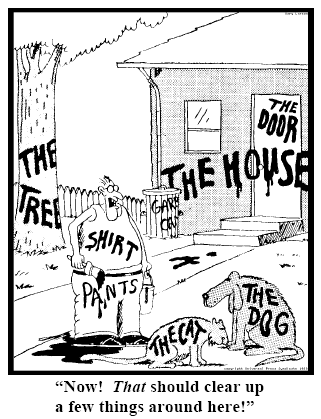
My stance, if I consistently have one, on the merits of static vs. dynamic typing is as follows:
- To the computer, all data is just a sequence of bits. The necessity of performing number operations on one sequence and date operations on another pretty much implies that the first sequence is a number and the second sequence is a more abstract Date. Data has a (strong) type so it can make sense and we can meaningfully manipulate it. Don't let that bother you.
- An interface with data types is more descriptive than it otherwise would be. Especially if your code intends for the third argument to be an object with the method scratchensniff. I shouldn't have to read your code in order to use it. Admittedly, data types still aren't good enough for telling you that, for instance, an integer argument must be less than 108. Where the language fails, convention and documentation and, most importantly, discipline can certainly suffice...like an identifier in ALLCAPS or beginning with an _underscore.
- Speaking optimistically, we programmers can see the big picture of what code is doing. We can tell exactly what will happen and to what, and for what reason. Compilers and computers don't, because compilers and computers can't read. However, when data is typed, the compiler can use that additional information to optimize.
- Leaving type unspecified automatically forces the code to work more generically, because the type is unknown. The code can be set loose on anything. It may throw a runtime error because of unsuitable data, but on the other hand it can handle cases the original writer never even thought of. This can also be done with generics or an explicitly simple interface, but not as conveniently.
- Not having the compiler be so picky about types and interfaces means that mock objects for unit testing are trivial.
- There is a significant overhead to keeping track of often-complex object hierarchies and data types. Knowing that function frizzerdrap is a part of object class plunky is hardly intuitive, to say nothing of static methods that may have been shoehorned who-knows-where. Thanks be to Bob, IDEs have gotten good at assisting programmers with this, but it's also nice to not have to search as many namespaces.
- Dynamic typing goes well with full-featured collections. Processing data collections is a huge part of what programming is. The more your collection enables you to focus on the processing, and not the mechanics of using the collection, the better. With dynamic typing, a collection can be designed for usability and then reused to hold anything. Some of the most confusing parts of a statically-typed language are its collections, whether the collection uses generics or the collection uses ML-style type constructors.
Wednesday, October 04, 2006
too good not to share
A funny quote from this page which quoted it from this page.
When we have clients who are thinking about Flash splash pages, we tell them to go to their local supermarket and bring a mime with them. Have the mime stand in front of the supermarket, and, as each customer tries to enter, do a little show that lasts two minutes, welcoming them to the supermarket and trying to explain the bread is on aisle six and milk is on sale today.Hilarious, but also a great lesson.
Sunday, October 01, 2006
prisoner's dilemma for P2P
Surely I can't be the first person to notice this, but the Prisoner's Dilemma has some applications to P2P. If you want a more thorough treatment of the Dilemma, look elsewhere. Here's the shorthand. There are two independent entities called A and B (or Alice and Bob, if you like). Each has the same choice between two possibilities that are generally called cooperate and defect. A and B don't know what the other will choose. The interesting part comes in the payoffs or profit margin of the four possible outcomes:
The Prisoner's Dilemma applies to P2P transactions in a limited way, if you consider the payoff to be the difference between downloads (positive) and uploads (negative). Assume A and B are two peers who wish to download something of equal value, normalized to be 1, that the other has (and everything's legal, yahda yahda yahda).
Nevertheless, the Prisoner's Dilemma shows that, assuming uploading or sharing has a cost, "leeches" are merely acting in a rational manner to maximize their individual payoff. So P2P systems that make it more rational, or even mandatory, to share stand a better chance of thriving. Specifically, if a peer downloads more than one item, the iterated or repeating Prisoner's Dilemma can come into play. A peer that acted as a leech for the last item could have some sort of penalty applied for the next item the peer downloads. Through this simple mechanism, known as Tit-for-Tat, cooperation becomes more attractive. Call it filesharing karma, only with a succession of files instead of lives. Any peer downloading its very last item would rationally defect on that item, because there would be no chance to receive a future penalty.
- If A cooperates and B cooperates, A and B each receive medium payoffs.
- If A cooperates and B defects, A receives a horribly low payoff and B receives a huge payoff.
- Similarly, if B cooperates and A defects, B receives a horribly low payoff and A receives a huge payoff.
- If A and B defect, A and B each receive low (but not horribly low) payoffs.
The Prisoner's Dilemma applies to P2P transactions in a limited way, if you consider the payoff to be the difference between downloads (positive) and uploads (negative). Assume A and B are two peers who wish to download something of equal value, normalized to be 1, that the other has (and everything's legal, yahda yahda yahda).
- If A uploads what B wants and B uploads what A wants, A and B both upload (-1) and download (1), so the payoff for each is 0.
- If A uploads what B wants and B does not upload, then A ends up with a payoff of -1, and B ends up with a payoff of 1.
- If A does not upload and B uploads what A wants, then A ends up with a payoff of 1, and B ends up with a payoff -1.
- If A does not upload and B does not upload, then no transaction occurs at all, so the payoff is 0.
- A and B both have what they wanted, in addition to what they uploaded, so each have a payoff of 1.
- A did not get what it wanted, but B did, so A's payoff is 0 and B's payoff is 1.
- A got what it wanted, but B did not, so A's payoff is 1 and B's payoff is 0.
- A and B both got nothing, a payoff of 0.
Nevertheless, the Prisoner's Dilemma shows that, assuming uploading or sharing has a cost, "leeches" are merely acting in a rational manner to maximize their individual payoff. So P2P systems that make it more rational, or even mandatory, to share stand a better chance of thriving. Specifically, if a peer downloads more than one item, the iterated or repeating Prisoner's Dilemma can come into play. A peer that acted as a leech for the last item could have some sort of penalty applied for the next item the peer downloads. Through this simple mechanism, known as Tit-for-Tat, cooperation becomes more attractive. Call it filesharing karma, only with a succession of files instead of lives. Any peer downloading its very last item would rationally defect on that item, because there would be no chance to receive a future penalty.
Subscribe to:
Posts (Atom)